Matlab Script to Read Sets of Data

Prior to MATLAB R2017b, MATLAB ships with Coffee 7, but ImageJ2 requires Java 8. You will need to modify your MATLAB installation to use Java 8, past following the instructions for your platform: Windows, macOS or Linux.
If you run MATLAB R2017b and later, yous don't need to do this, every bit it ships and uses Java 8 already.
ImageJ-MATLAB is an extension which:
- Translates data betwixt ImageJ2 images and MATLAB matrices.
- Enables execution of MATLAB scripts from inside ImageJ2's Script Editor.
- Lets you lot launch ImageJ2 and interact with it from within MATLAB.
- Allows developers to write additional plugins which extend these capabilities in new directions.
MATLAB tutorial for ImageJ2
Prerequisites
- Add the ImageJ-MATLAB update site. See Post-obit an update site for more detail.
- Yous go to Help › Update…
- Once checking status is washed, click
- Tick "ImageJ-MATLAB" and then

- And and then click on ImageJ Updater
- This will literally update and supersede the existing, non-functional
ImageJ.yardfile in the scripts folder with the 18-carat ane.
- You will demand to install your own licensed copy of MATLAB. All that ImageJ-MATLAB provides is adapters for evaluating scripts written in ImageJ2 to MATLAB, and converters between ImageJ2 and MATLAB data structures.
- Prior to MATLAB R2017b, MATLAB ships with Java 7, but ImageJ2 requires Java 8. You lot will need to alter your MATLAB installation to apply Java 8, by following the instructions for your platform: Windows, macOS or Linux. If you run MATLAB R2017b and afterward, y'all don't need to do this, every bit it ships and uses Java eight already.
- The control
version -javawill return the current Java version used past MATLAB
- The control
- If you lot're new to MATLAB, get-go cheque out Mathworks' getting started guide.
- If you lot're familiar with the MATLAB language but haven't written .chiliad scripts before, expect through the script examples.
Retentivity issue
- In social club to handle large images, the default Java Heap Memory size assigned won't be enough and you may become the error
java.lang.OutOfMemoryError: Java heap space. - From MATLAB R2010a onward, you can increase the Jave Heap Memory size from Preferences › General › Java Heap Retention .
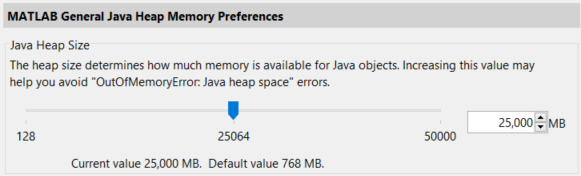
- Nonetheless, the maximum value allowed in the Preferences tin can still be too small for your purpose. In that case, you can straight edit
matlab.prffile in the folder specified by theprefdir<\\lawmaking> MATLAB function (eg. `C:\Users\xxxxxxx\AppData\Roaming\MathWorks\MATLAB\R2018b`). Find the parameter `JavaMemHeapMax` in the file and increment the number that follows the majuscule I (in MB) to increase the maximum Java heap memory size. The change will exist reflected past the Preferences every bit in a higher place.
- Alternatively, this tin can besides be done past creating a
coffee.optsfile in the startup directory and overriding the default memory settings (see this documentation for more information). For instance,-Xmx512min yourjava.optsfile may exist a good start point. - For the mutual "Out of Memory" error, see the Troubleshooting folio.
Creating MATLAB scripts inside ImageJ2
Using the Script Editor you will be able to select MATLAB from the language menu. You tin can likewise install and run .m scripts via the standard script plugin infrastructure.
Actually running a MATLAB script from ImageJ2 is effectively similar calling eval on the script'south contents. The script will be evaluated as such in a remote MATLAB example (which volition be launched automatically, if needed). Annotation that only scripts, not functions, tin be evaluated in this way. Meet the MATLAB documentation for an explanation of these concepts.
NB: Because of the similarity to
eval, when you need to assign character vector or cord with special characters, they need to be escaped. A typical instance is the treatment of file/folder paths in Windows. Thus,south = 'C:\Users\xxxxx\Desktop'will end up in an error in MATLAB:
Alarm: Escaped character '\U' is not valid. See 'doc sprintf' for supported special characters. scijava_script523255 = 's = 'C:' Error: Graphic symbol vector is not terminated properly.You need to escape backslashes as below:
s = 'C:\\Users\\xxxxx\\Desktop' s = 'C:\Users\xxxxx\Desktop'For more than details, run across documetation for
sprintfand learn near Special Characters.
Options for controlling the startup of MATLAB, or killing existing MATLAB processes (e.grand. if subconscious) tin be accessed via: Edit › Options › MATLAB…
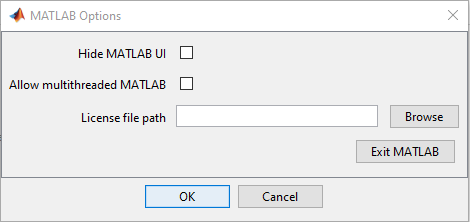
Considering the script is beingness passed from ImageJ2 to a remote MATLAB, MATLAB will non accept access to ImageJ2's classpath. Objects tin can be passed every bit variables to MATLAB (e.g. past using script parameters) but only if they are valid MATLAB classes or especially handled classes.
Scripts requiring directly admission to classes from ImageJ2, or from the original ImageJ (without auto-conversion support) should launch ImageJ2 from inside MATLAB.
E.g. a script using ij.IJ commands needs to exist run from within MATLAB (or you'll need to add Coffee class paths to MATLAB search path before calling ij.IJ commands).
For example, by default all MatlabNumericArrays will exist converted to matrices within MATLAB. We also support automobile-conversion of ImageJ2 Dataset out of the box, which can be read in by scripts using matrix parameters:
#@ matrix data #@output net.imagej.Dataset rval #@output cyberspace.imagej.Dataset mask % Performs dilation with a 3x3 square, % operating on the active dataset % Outputs the dilated mask and the original image % with the mask applied. rval = uint8(data); % catechumen to uint8 rval = mat2gray(rval); % normalize data mask = im2bw(rval,0.5); % make logical mask se = strel('foursquare',3); % create structure to apply in dilation mask = imdilate(mask,se); % perform dilation on the mask rval(~mask) = 0; % subtract mask from original dataset This script will accept the active Dataset, gear up it as an array variable named "data" in MATLAB, and set the matrixSum output value to the sum of the starting time iii dimensions of the dataset.
Global state
MATLAB retains state (east.k. declared variables) as commands are executed, and ImageJ2 makes no special effort to clean upwardly after a script. So whether running internally or communicating externally with MATLAB, country will exist bachelor to and persist after script execution. Thus i tin, for example, write scripts in ImageJ2 referencing variables declared in MATLAB, without actually initializing them in the script.
Passing Objects
The caveat to global land is that, when running ImageJ2 externally, ImageJ2 and MATLAB run in separate JVMs. As a issue, well-nigh objects can not exist passed between the two. This makes Datasetsouthward (and arrays) the currency that is passed between these applications.
Return values
Most of the scripting languages supported past ImageJ2 have implicit render values. Every bit mentioned above, ImageJ2 will but execute true scripts, which exercise not have return values (in the MATLAB functional sense). There is a similar concept in the ans variable, which automatically gets the return value of executed statements if they are not explicitly assigned. Still, due to the global nature of the ImageJ-MATLAB script language, it is not necessarily clear if ans was set up by the script or a pre-existing command. Thus the conclusion was made that ImageJ-MATLAB scripts will never implicitly return a value. Instead, the #@output annotation should e'er be used - even for ans, as shown here:
#@output double[] ans % This trivial script demonstrates the use of % the "ans" variable in the SciJava-MATLAB % script linguistic communication. % Unassigned statements in MATLAB are automatically % assigned to "ans". All the same, these scripts volition not % return "ans" unless it is explicitly requested as % an output parameter. 0 Importing classes
To reference Java classes from MATLAB yous volition need to import them.

Different the original ImageJ, ImageJ2 (and therefore Republic of the fiji islands) does non automatically import any classes. Consequently, scripts written for ImageJ will not run in ImageJ2 without adding the proper imports. The rationale is that the automobile-import feature is non safe. What if two classes of the same name live in two unlike packages? Or if a new grade is introduced that makes formerly unique names ambiguous? Suddenly, all of the scripts that reference the original course no longer piece of work. In short: auto-imports are dangerously imprecise.
When running ImageJ2 externally, MATLAB will non have ImageJ2 classes in its classpath - and then they tin not simply be imported. Although MATLAB does support editing its classpath this is Non recommended, as the classes loaded by MATLAB volition not be the same as those loaded in ImageJ2.
Instead, you can launch ImageJ2 inside MATLAB and take it take care of managing the class loading for you lot. MATLAB then supports the utilise important statements to simplify class names.
Running ImageJ2 within MATLAB
The ImageJ-MATLAB update site provides an ImageJ.m script that will get-go up an ImageJ2 instance inside a running MATLAB application. Launching the script is the aforementioned as for Miji:
addpath '/Applications/Republic of the fiji islands.app/scripts' % Update for your ImageJ2 (or Fiji) installation as appropriate ImageJ; Now, yous should see a new ImageJ2 case shows up as a window. 
In your MATLAB base workspace, you'll notice a variable IJM, which is a internet.imagej.matlab.ImageJMATLABCommands Java object. IJM offers a few useful methods as below:
-
IJM.getDataset()creates a MATLAB matrix from the agile ImageJ2 epitome using its window championship as the variable proper noun (incompatible characters like.volition be escaped with_). The MATLAB matrix is indoubleblazon. Although the X and Y axes are swapped, the third to fifth dimensions of the data are preserved. -
IJM.getDatasetAs(name)creates a MATLAB matrix from the active ImageJ2 paradigm, and assigns information technology to the specified variable proper nameproper noun. -
IJM.show(name)takes the MATLAB matrix with the specified namenameand displays information technology as an image in ImageJ2. The prototype is always in 32bit type. The X and Y axes are swapped. The third to fifth dimensions of the original MATLAB matrix are all piled in the 5th dimension and interpreted as time frames.
In the MATLAB command window, you'll run into something like this:
-------------------------------------------------------------- ImageJ-MATLAB 0.7.ii: MATLAB to ImageJ Interface -------------------------------------------------------------- JVM> Version: ane.8.0_144 JVM> Total amount of memory: 370176 Kb JVM> Amount of free retentivity: 122756 Kb -- Welcome to ImageJ-MATLAB -- ImageJ-MATLAB consists of an extensible prepare of commands for passing information between ImageJ and MATLAB. See the individual sections beneath for a listing of bachelor commands. For more than information and examples see: https://imagej.net/scripting/matlab --- MATLAB Command Plugins --- -- ImageJ MATLAB commands -- Usage: IJM.[command] help - prints a brief description of available commands getDataset - creates a MATLAB matrix from the active ImageJ paradigm getDatasetAs(proper name) - creates a MATLAB matrix from the active ImageJ image, and assigns it to the specified variable proper noun prove(proper noun) - takes the MATLAB matrix with the specified name and displays information technology as an image -------------------------------------------------------------- Status> ImageJ is running. -------------------------------------------------------------- The startup procedure automatically injects the ImageJ2 classpath into the MATLAB classpath, merging the 2. At this bespeak, you'll have a working ImageJ2 and can now run MATLAB scripts as normal with access to the full unified classpath.
Useful Commands
Show a MATLAB array I every bit an image in ImageJ2
-
using
IJM -
using the original ImageJ'south
ImagePlus(see)imp = copytoImagePlus ( I ); imp . show (); -
using ImgLib2
ArrayImgimg = copytoImg ( I ); internet . imglib2 . img . display . imagej . ImageJFunctions . show ( img );
Retrieve an image data in ImageJ as a MATLAB array I
-
using
IJMwith the current window title as the variable name -
using
IJMwith the variable nameI -
from ImgLib2
Img
Quit the ImageJ case from MATLAB control line
```matlab ij.IJ.run("Quit",""); ``` Known Problems
Mutual Issues
- Although the first and second dimensions, respectively, of MATLAB assortment are treated as rows (Y)and columns (10) in MATLAB, the first and second dimensions of an array are treated equally 10 and Y, respectively, in ImageJ2. The axes are transposed past
IJM.show(name),IJM.getDataset(),IJM.getDatasetAs(name). (Come across discussion here for details) -
IJMobject is always added to the MATLAB base of operations workspace. In order to admissionIJMmethods from within a MATLAB function, you'll need to employassignin,evalin, and/orglobal(see here for details) -
When launching ImageJ2, you'll run into the error message beneath:
log4j:WARN No appenders could be constitute for logger (loci.formats.ClassList). log4j:WARN Delight initialize the log4j system properly.
Issues specific to IJM.show(name)
- A multi (>ii) dimensional image (with multi-channels, slices or time frames) is treated as single channel images with multiple time frames irrespective of the dimensions. For example, if a MATLAB assortment
Ahas the size[i,j,k], wherei,j, andkcorrespond to the sizes in rows, columns and channels, soIJM.show(name)will evidence information technology equally[j,i,ane,one,k], where Ten and Y axes are flipped over (see below) and channels are interpreted as frames. On the other hand,IJM.getDataset()andIJM.getDatasetAs(proper noun)can maintain the dimensions of the paradigm data (except the flipping over of X and Y axes).- From GUI, you can set this by Image › Hyperstacks › Re-club Hyperstack…
- For a scripting-based solution, you lot can run
ij.IJ.run("Re-order Hyperstack ...", "channels=[Frames (t)] slices=[Slices (z)] frames=[Channels (c)]");in MATLAB for the example above to have dimensions[i,j,k,1,1]in XYCZT format. Encounter here for details. - When you have multiple channels, slices and frames, they're all damped into the 5th dimension, and so it takes extra effort to correct the data format.
- Also, data is always handled as 32bit (int32) per channel. Conversion to 8 fleck or 16 bit images require an actress intendance to avoid unwanted scaling of numeric values (see here for details)
Solution to IJM.show(proper name) issues
- Until someone can fix
IJM.testify(proper noun)properly, consider usingcopytoImagePlusMATLAB function instead. It solves all the problems ofIJM.show(name)descrived above and create an ImagePlus hyperstack. Come across the case of a 5D Hyperstack below. -
copytoImgandcopytoImgPlusMATLAB functions are also available fromFiji.app/scriptsbinder to allow y'all convert a MATLAB array to ImageJ2 (ImgLib2)ImgandImgPlusobjects, respectively. See also this page.
Examples
Accessing ImageJ Java API from MATLAB
The following Java commands piece of work in MATLAB command window to open a sample image in ImageJ.
imp = ij.IJ.openImage("http://imagej.nih.gov/ij/images/boats.gif"); imp.evidence() 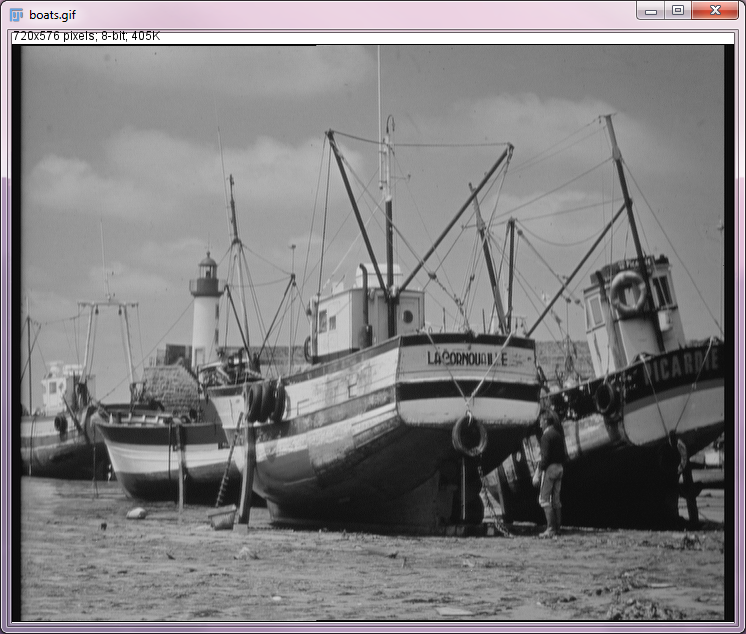
Opening a MATLAB array as an image in ImageJ2
The following will open up a MATLAB array information as an image in ImageJ2. Note that the X and Y of the epitome are transposed in ImageJ2 in the second image (encounter Limitations of IJM.prove() to a higher place).
corn_gray = imread('corn.tif',3); imshow(corn_gray); % evidence in MATLAB IJM.evidence('corn_gray'); % show in ImageJ2 corn_gray_tp = corn_gray'; % transpose assortment IJM.show('corn_gray_tp'); % prove in ImageJ2 properly 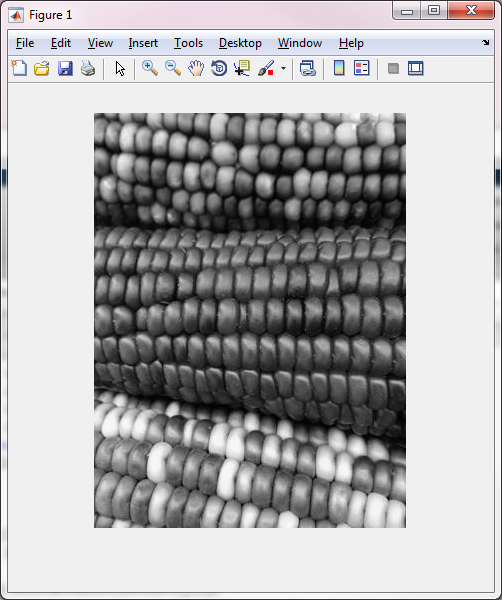
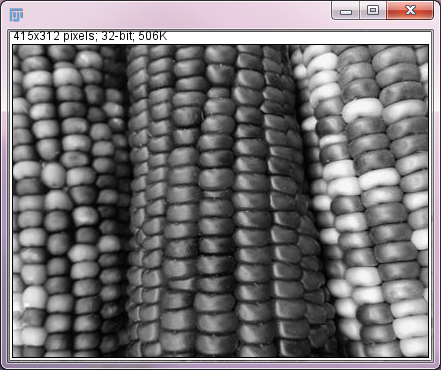
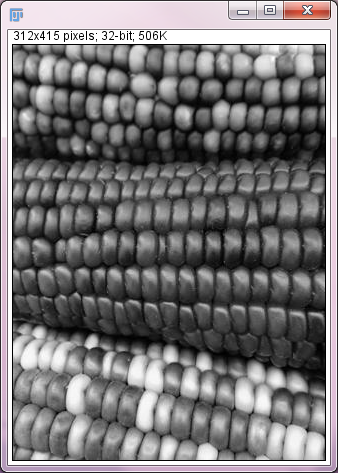
A more full general solution to this issue of Ten-Y transposition can be achieved by permute function of MATLAB. But please beware of memory demands past permute.
% I is a MATLAB array with ii or more dimensions guild = [{2, 1}, num2cell(3:ndims(I))]; I2 = permute(I,[order{:}]); IJM.prove(I2) % this will show an epitome in proper Ten and Y If you wish to show an image with ImageJ from inside a MATLAB function, you can reach that past using copytoImagePlus as beneath:
function demofun() corn_gray = imread('corn.tif',3); imp = copytoImagePlus(corn_gray); imp.show(); end Retrieving a MATLAB array data from an image in ImageJ2
Additionally, the Scripting-MATLAB library also includes an extensible MATLAB control framework. This allows for the creation of utility classes that will exist automatically populated into MATLAB variables for piece of cake admission. For example, you could use ImageJ2 to open a dataset and perform thresholding (or any other processing steps), then in MATLAB employ the IJM.getDatasetAs(proper name) command to prepare the agile dataset as a MATLAB matrix variable with a specified name, for further analysis.
For example, instead of using a script as described above, we could reach the same result by executing the following commands in the MATLAB prompt:
IJM.getDatasetAs('information') % import the prototype every bit a MATLAB matrix rval = uint8(data); % convert to uint8 rval = mat2gray(rval); % normalize information mask = im2bw(rval,0.five); % make logical mask se = strel('square',3); % create construction to employ in dilation mask = imdilate(mask,se); % perform dilation on the mask rval(~mask) = 0; % decrease mask from original dataset IJM.testify('rval') % display the rval array in ImageJ2 IJM.show('mask') % display the mask array in ImageJ2 If you wish to assign the numeric data of an ImageJ2 epitome into the Workspace of a MATLAB function, rather than the base Workspace, y'all tin reach that by making the variable global as below:
function demofun() evalin('base','global data'); evalin('base','IJM.getDatasetAs(''data'')'); global information % information is at present available in the Workspace of this office disp(size(data)) articulate global data % leaving a global varibale can cause unexpected problems end Opening a 2D-5D MATLAB array every bit a Hyperstack in ImageJ
If you use copytoImagePlus, yous tin open a 2D-5D MATLAB array as a Hyperstack with the right epitome type (8bit, 16bit, and 32bit for uint8, uint16, and other types of MATLAB array, respectively) in ImageJ with a simple syntax. Also, y'all tin use copytoImagePlus within a MATLAB function independently of the IJM variable in base of operations workspace.
imp = ij.IJ.openImage("http://imagej.nih.gov/ij/images/Spindly-GFP.nil"); imp.bear witness(); IJM.getDatasetAs('I'); % I is 5-D double with the size of 171x196x2x5x51 in MATLAB I16 = uint16(I); IJM.show('I16') % ImagePlus, 32-scrap, 171x196x1x1x510 imp4 = copytoImagePlus(I16,'XYCZT') % ImagePlus, 16-bit, 171x196x2x5x51 imp4.show(); IJM.show(name) cannot reproduce the dimensions and the data type. Channels (C), slices (Z), and frames (T) are all treated as frames. Paradigm type is 32 bit. 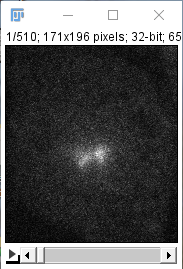
copytoImagePlus can go along the dimensions and the data type. 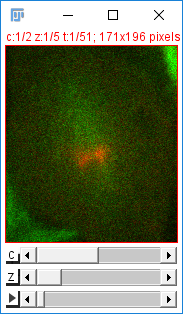
Source
- Scripting-MATLAB provides the script engine plugins.
- ImageJ-MATLAB defines the ImageJ2-specific translators.
Video presentation
ImageJ+MATLAB: Reunited
Source: https://imagej.net/scripting/matlab
0 Response to "Matlab Script to Read Sets of Data"
Post a Comment